
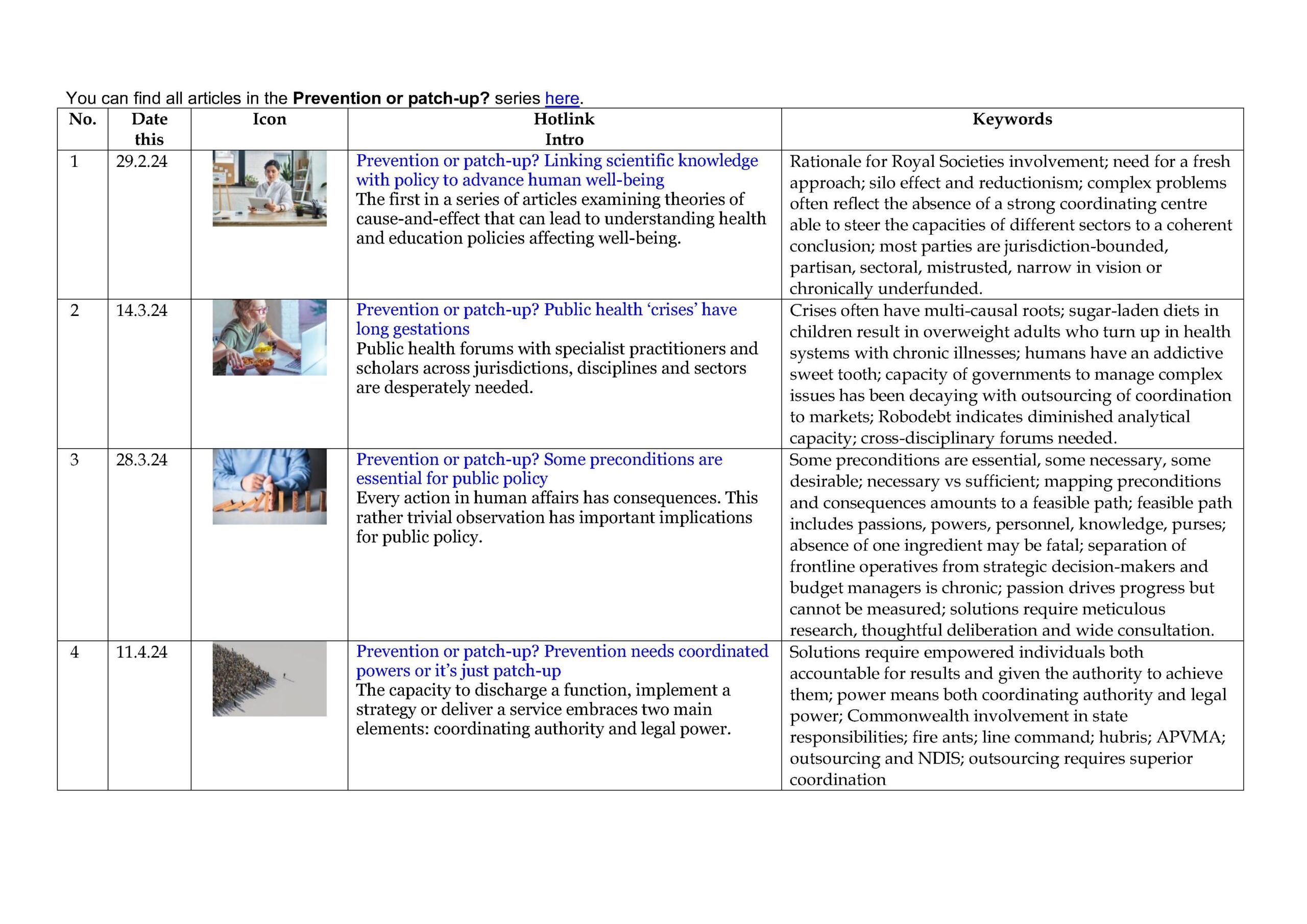
The first main limb of the “Preconditions of well-being” project has been the publication incrementally of a series of opinion pieces, nominally 1200 words each, by The Mandarin online newsletter of public administration. The series is entitled “Prevention or patch-up?”. While the articles are opinionative, they are grounded in scholarly analysis of evidence and insights from a range of authoritative sources. To validate articles, a cross-disciplinary Editorial Panel has been established.
It is hoped that the articles will be source material for publications in other formats such as articles in one of the member Societies’ peer-reviewed journals, press releases, policy submissions or aggregated into a monograph.
Emerging themes
To date the articles have identified the following themes. The list will be augmented as the series evolves.
- The human body is fundamentally a biological entity upon which sociological and economic forces are superimposed.
- A starting point for understanding the conditions necessary for humans to thrive is to consider the conditions to which Homo sapiens was adapted during its hunter-gatherer status and the changes visible in modern industrial society.
- The well-being of the population is in the ‘public interest’ and should be a (or the) primary concern of governments. Many positions aired in policy circles such as market efficiency, individual freedom and government intervention are best described as means to that end, often contestable, but the end outcome, the flourishing of Australians, should not be controversial.
- Many of the preconditions of health and well-being lie in the provision of public goods which by definition are under-provided by commercial markets. Public goods require financing by civic or government (taxation) sources. Market neoliberalism cannot adequately explain how to deliver the public goods essential to human development.
- Corporations are not required to advance the public interest as their primary purpose. The activities of many corporations, such as those involved in the gambling, alcohol and pornography industries are not prima facie conducive to well-being and require firm policy leadership and regulation by governments on behalf of the community.
- Governments must be continually cautious of undue influence by regulated industries are common. For example, industry representatives should not be voting members of decision-making boards.li>
- Regulation is not necessarily antagonistic to individual self-determination. Regulation defines and secure rights and freedoms of the general public.li>
- The tension between individual accountability for managing one’s life and civic/community/government accountability, being one of the major cleavages of partisan politics, may not ever be resolved, but must be considered compassionately, as individuals’ life trajectory is set from before birth.li>
- Financial inequality entrenches disadvantage and poor well-being from one generation to the next. Minimising inequality is necessary for a society’s well-being.
- Bringing up children is a responsibility of the entire community.
Summaries of articles
The articles are behind a paywall requiring a subscription to The Mandarin, but in due course will be re-formatted for open access.
Articles 1-20, February-December 2024
Click here for a PDF tabulation of the first 20 articles, including keyword-focused summaries and live hotlinks to the original articles.
Click here for a screenshot of the header page of the first 5 articles and here for the next 15, in chronological sequence from latest to earliest.